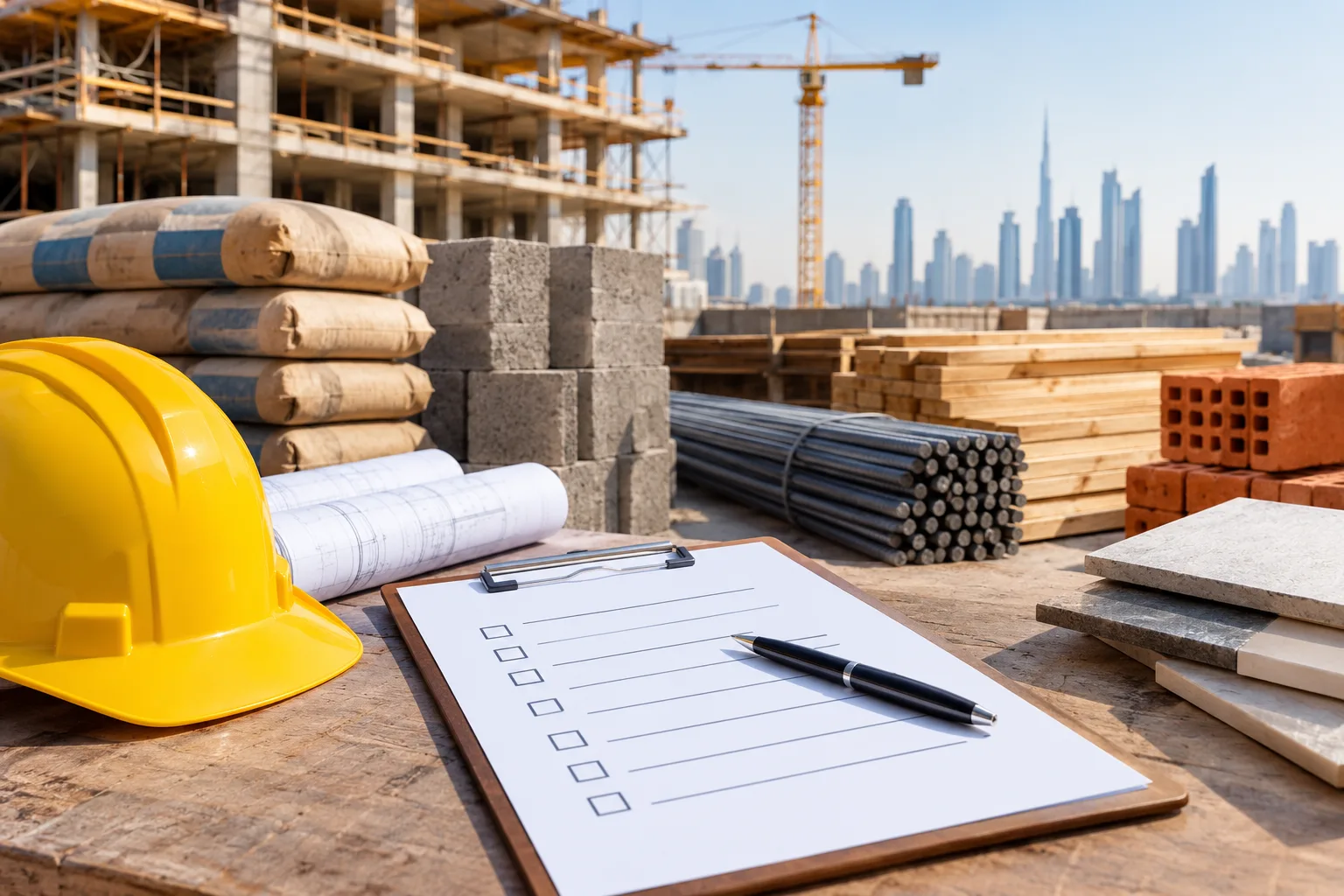
Procuring building materials for a construction project in Dubai involves more than comparing prices and placing an order. Planning quantities, choosing a building materials supplier in Dubai, checking the paperwork, and inspecting what actually arrives – all of it feeds into the same outcome: whether your project stays on budget and on schedule.
Most of the problems contractors deal with mid-project are a shortage that halts work, a delivery that doesn't match spec, a late shipment, or something skipped earlier in procurement. The sections ahead go through what to check at each stage, starting with how to evaluate a supplier and working through to the mistakes worth avoiding altogether.
How to Plan Building Material Procurement Before Starting a Project?
Planning building material procurement means working out exactly what a project needs before requesting a single quote, not adjusting the order once work has already started. Most procurement problems don't start at the ordering stage. They start earlier, when someone works off a guess instead of the actual drawings, and that gap only becomes obvious once materials are already short or wrong.
- Start with the drawings. Confirm what each phase actually needs before assuming you already know.
- Lock in specifications early, including dimensions, brand preferences, and technical requirements, so any substitution gets caught before it reaches your site.
- Add a buffer when estimating quantities. Materials like tiles, cement, and gypsum boards run short more often than people expect, and a shortfall stops work fast.
- Time deliveries with the actual schedule. Early deliveries risk damage from sitting unused, and late deliveries leave the crew with nothing to work on.
When this part is done right, most of the guesswork disappears from the purchasing decisions that follow.
What Should You Check When Choosing a Building Materials Supplier in Dubai?
Choosing a building materials supplier in Dubai comes down to five things worth checking before you sign off on anyone: what they stock, how reliable their quality is, how much relevant experience they carry, whether they back order with proper paperwork, and whether they can actually hit your delivery dates. Skip this step, and you tend to find out the hard way, usually mid-project, when a gap in one of these areas turns into a delay you didn't plan for.
- Product availability across the categories you need, so you are not managing separate suppliers for every material type.
- Quality standards, including whether the supplier stocks branded products with verifiable certifications
- Experience with projects similar in scale to yours, whether residential, commercial, or industrial
- Documentation support, meaning the supplier can provide compliance paperwork without delay
- Delivery capability, including whether bulk orders can reach your site on schedule
Meeting these points does not guarantee a flawless process, but it does reduce the coordination work on your end and lowers the odds of last-minute changes that compromise your specification.
What Documents Should You Verify Before Purchasing Building Materials?
Before purchasing building materials, verify four categories of documents: specification sheets, compliance certificates, test reports, and purchase documentation. Each one serves a different purpose, and skipping any of them tends to cause problems only after the material is already on site, which is the worst time to find a gap.
- Product specification sheets confirm that what you are buying matches what you specified in your drawings.
- Compliance certificates are issued to verify that the product complies with the technical requirements of the UAE, especially for products that are regulated, such as fire-rated boards or electrical components.
- Test reports become relevant for structural or safety-critical materials, where a manufacturer's claim alone is not proof of performance.
- Purchase documentation, including invoices, delivery notes, and warranty terms, should be kept together for each order.
Keep these on file. If a defect surfaces after installation, or a consultant asks for proof of material origin during inspection, this is what you will need.
How to Inspect Building Materials Before Accepting Delivery
Inspecting building materials before accepting delivery means checking four things: quantity, condition, specification match, and packaging, before the truck leaves your site. Once it drives off, correcting a mistake gets a lot harder, which is why this check is worth doing properly every time, not just when something looks off.
- Quantity verification, matching the delivered count against your purchase order line by line.
- Product condition: check for any cracks, moisture damage, or corrosion that may occur during shipping or storage.
- Matching specifications means confirming that items match your approved specification exactly, including size, finish, and model number, because a close match is not the same as a correct one.
- Packaging and storage checks ensure that the packaging is in good condition and that your site is safe for the material before it leaves the truck.
Cement and gypsum boards especially decay quickly if left in damp or exposed conditions; thus, get storage worked out before delivery arrives, not after.
What Common Mistakes Should You Avoid During Material Procurement?
The most common mistakes during material procurement are choosing suppliers on price alone, ignoring lead times, skipping quality checks, and poor documentation tracking. These show up across projects of very different sizes, and most of them come down to rushing a decision that deserved a bit more attention.
- Choosing only based on price, which often backfires when quality or delivery reliability falls short.
- Ignoring lead times, which creates gaps between phases when imported items take longer to arrive than expected.
- Skipping quality checks, which lets defective batches reach the site, and fixing the problem later always costs more than catching it at delivery would have.
- Poor documentation tracking, which confuses things later during audits, warranty claims, or disputes with your consultant.
None of these are complicated to fix. They just need to be treated as part of the process rather than an afterthought.
How to Maintain Better Control Over Material Procurement
You have more control over the purchase of materials by keeping accurate records, staying in constant communication with your suppliers, and planning ahead for the next phases. Of the three habits, none of them is more important than another; those contractors who make them a part of their routine tend to spend significantly less time firefighting mid-project.
- Maintain records, keeping a running log of every order, delivery, and inspection result so there is a clear trail if questions come up later.
- Coordinate with suppliers regularly rather than only at order time, since ongoing contact gives you advance notice of stock issues or price changes.
- Plan future requirements by reviewing your next phase's material needs while the current phase is still underway.
Do this consistently, and the last-minute scramble that leads to rushed, poorly vetted purchases mostly disappears on its own.
Why Choose Service First for Building Materials in Dubai
At Service First, we provide high-quality building materials for residential, commercial, and industrial projects across Dubai. Our product range includes AC components, electrical supplies, plumbing materials, construction products, hardware tools, and other building essentials to support different project requirements.
We focus on helping contractors access the materials they need with reliable product availability and the right information for informed purchasing decisions. Explore our collection of building materials to find suitable products for your upcoming construction and maintenance projects.